
What should we do about all this AI money?
A conversation between two veterans of philanthropy in the Bay Area.

Hundreds of billions in AI wealth will soon become liquid, marking what we hope will be the beginning of the biggest wave of tech philanthropy yet. This spring, a widely shared essay by Nan Ransohoff outlined the work that lies ahead: With new capital imminently available to support the equivalent of 5,000 Institutes for Progress or 100 GiveWells, money will arrive faster than anyone can currently absorb.
The prevailing belief among our peers is that Silicon Valley is especially well-positioned to turn its wealth into good outcomes for the world. At Asterisk, we think tech has a mixed track record, especially when it comes to handling windfalls. How will this money actually be spent? Can we find talented operators to absorb it? Are we all too myopically obsessed with the idea of talented operators? And, yes, really — what does this mean for democracy?
On July 9, we hosted a discussion between Rob Reich, a political theorist at Stanford University and author of the book Just Giving — a dedicated investigation of philanthropy’s place in a democratic society — and Alexander Berger, CEO of Coefficient Giving, to discuss these topics, moderated by Clara Collier, our editor in chief. Both Rob and Alexander have spent their careers immersed in both the history and practice of philanthropy. They have known each other for a long time, and the conversation was as lively and candid as we’d hoped.
The following is a recap of their conversation, as well as a few questions from our audience that included founders, lab employees, and professionals in the philanthropy sector. This conversation has been lightly edited.
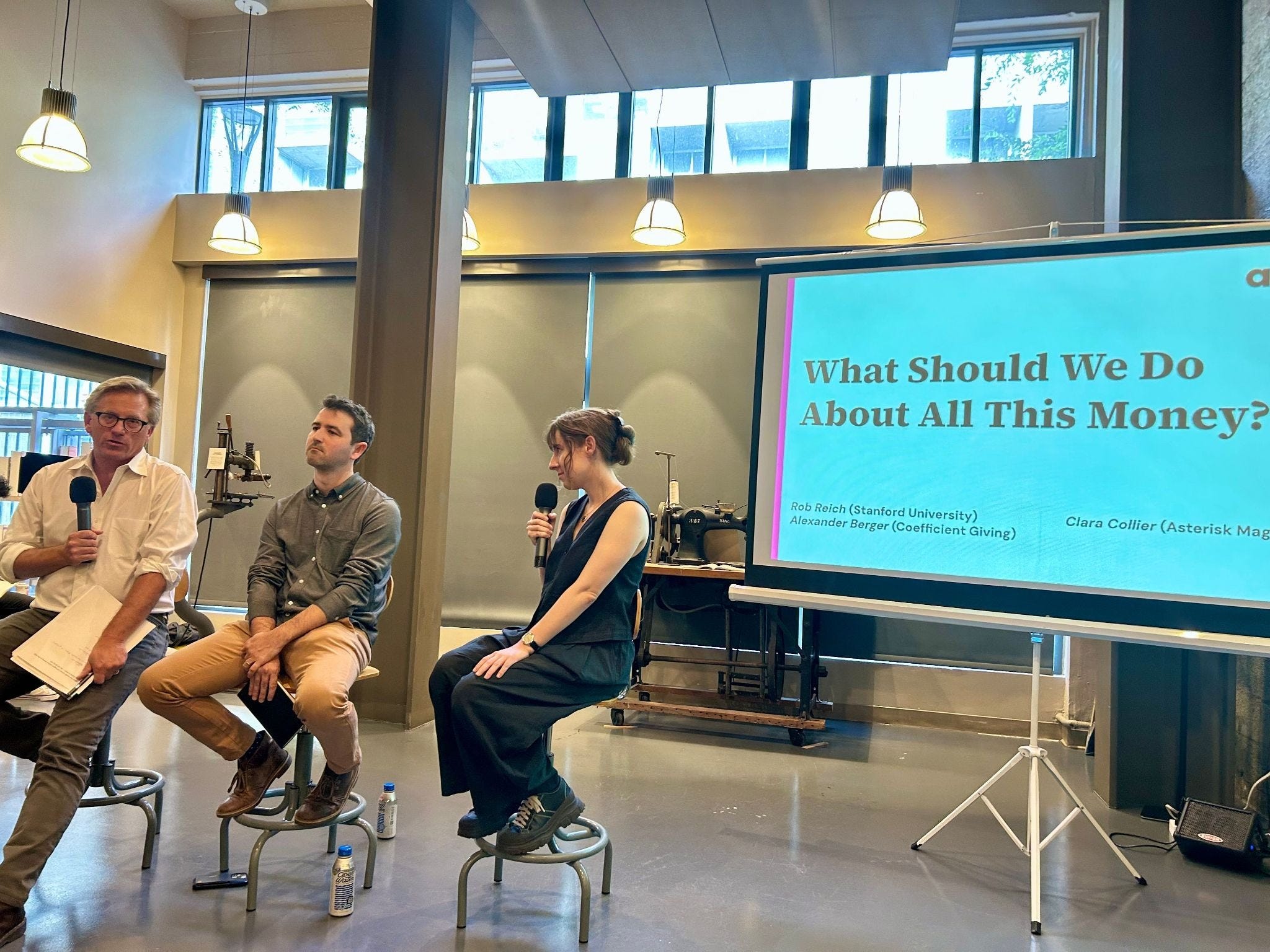
(Note: Asterisk print subscribers are invited to events like these. Subscribe to our print magazine to attend future events.)
Reactions to Nan’s essay
Alexander: I thought it was a very useful essay. Anytime there are multiple New York Times columns about your Substack essay, you know you’ve done something right. Nan identified a real and important trend, synthesized and popularized it well, and got the world to pay attention. That was an important service. However, I have three caveats or critiques.
First, some thoughts on the specific estimates she uses: If you use rough, order-of-magnitude numbers, the figures in the essay seem reasonable to me. At current valuations, between OpenAI Foundation and Anthropic donors, we’re talking about perhaps $400 billion in philanthropic assets.
I think Nan is right that these donors may spend faster than others have historically, so an annual spending rate around 10 percent is not a crazy assumption.
But both of those inputs are highly uncertain, because they depend on the valuations of two specific and potentially volatile companies. This would also be an unprecedented philanthropic surge, so how quickly it materializes, especially in the early years, is highly uncertain. The range of possible outcomes is much wider than a point estimate of $40 billion a year might suggest.
Second, Nan emphasizes the ways in which this wave is different from prior philanthropy, whereas I would begin by seeing more continuity, with the major change being scale. Even $40 billion a year is less than a 10% increase in total U.S. charitable giving. That is still roughly five Gates Foundations in scale. The Gates Foundation is the largest current philanthropic spender in the country, so this is a huge deal. Getting five Gates Foundations off the ground is a really big ongoing challenge. That’s not trivial and it’s important to prepare for it. But it’s also not necessarily a total break with the past. It’s the kind of thing that the Gates Foundation has done once, so there’s a precedent for doing that kind of thing.
Getting five Gates Foundations off the ground is a really big ongoing challenge. That’s not trivial and it’s important to prepare for it. But it’s also not necessarily a total break with the past.
Another way to understand the magnitude is to compare it with the 2025 cuts to U.S. foreign aid under DOGE, which were also roughly $40 billion a year. At minimum, the new funding could refill those government cuts. There may be more effective things to do than simply refill those cuts, but that comparison gives a floor for understanding the amount of money involved. It is not historically unprecedented to direct that scale of resources toward social purposes.
Third, I read Nan’s essay as a distinctly Silicon Valley document. There are places where that framing could go further, especially because OpenAI and Anthropic are AI companies with distinctive views about the future of the world. If anything, Nan may understate how consequential this will be for the shape of future AI philanthropy.
In areas such as AI safety and AI for good, we should expect historically large increases in the speed and scale of giving. But across philanthropy more broadly, there is already a great deal of work devoted to making the world better that could appeal to these donors, especially the more diffuse group of individual donors. We don’t necessarily need to rethink all of philanthropy from first principles. On the AI side, that’s actually going to be a huge can of worms, and it’ll be interesting to see how that plays out.
Rob: I was invited to this event because I’m known as a particular kind of critic of Big Philanthropy. Unlike Anand Giridharadas, perhaps, who wrote a bestselling polemic, I have both a severe critique and a redemption story to offer. That’s the frame I’ll bring to the conversation.
Alexander appropriately asks whether the back-of-the-envelope math about how much philanthropic capital is about to enter the system is roughly right. He says it is probably in the ballpark. I think there’s a possibility that it is a radical overestimate, but also a possibility that it’s a radical underestimate.
On the overestimate side, even though the essay is called “The Third Wave of American Philanthropy,” in the two previous waves of wealth concentration, where there have been very public efforts to shift private assets into philanthropic capital, giving rates even amongst the wealthy have tended to be relatively flat at, say, 1% or 1.5% per year, as opposed to Nan’s estimates in the range of 10% of philanthropic capital. Lyell Sakaue describes this aptly: philanthropic liquidity is not philanthropic generosity. Why is that? The answer is less the project of any individual donor but more the prevailing corporate structures to direct considerable and sudden accumulations of philanthropic assets.
Giving rates even amongst the wealthy have tended to be relatively flat at, say, 1% or 1.5% per year, as opposed to estimates in the range of 10% of philanthropic capital.
Donor-advised funds are a scandal. The wealth-advisory industry is marketing them to newly wealthy Anthropic employees: “Take full advantage of the tax benefits and park your money in a donor-advised fund for as long as you wish, until you feel you have a strategy for giving it away.”
Donor-advised funds warehouse philanthropic assets while providing the donor with a full private tax benefit. In that respect, they absorb potential philanthropic capital without producing any corresponding social benefit, because the money typically sits idle in an investment account for a long time. Their structure is perverse in at least two respects.
First, there is no annual payout requirement, unlike a private foundation. Second, the entity holding the fund earns fees on the assets under management, so it has an incentive to keep the money invested rather than push it out the door.
Private foundations are another way to keep money inside a philanthropic entity while paying out only 5 percent a year, while anointing oneself as the creator of a potentially perpetual institution. I agree with Alexander that this cohort of AI-generated wealthy people may be less likely to establish perpetual legacy institutions primarily concerned with their own reputations — although we should wait and see. This opportunity to transmit family values through a private family foundation can suddenly seem attractive when wealth advisers present it that way.
Even if Nan is right that a great deal of money will be moved into philanthropic vehicles, we may not see a comparable social benefit if it remains warehoused in donor-advised funds or private foundations. That is the case for the estimate being too high. What is the case for it being too low? It depends on who’s making the money.
If, as Demis Hassabis tells us, we’re living in the foothills of the singularity, and if, as Dario Amodei tells us, we’re in the technological adolescence of AI, perhaps we’re only 10 years from a post-AGI future. That post-AGI future is said to offer a world of abundance, a life beyond scarcity in material necessities. If that is true in 10 or 20 years, the case for spending philanthropic capital now becomes much stronger, because there may be fewer causes requiring philanthropic capital in a post-AGI landscape of abundance.
The AGI-pilled people who become stewards of great philanthropic wealth may therefore feel compelled by their own worldview to spend much more annually before that future arrives. There is also the question Alexander raised of managing the transition and steering away from catastrophic risks on the path to a post-AGI society. AI safety may already have a great deal of money, but much more could be coming.
If the soon-to-be Anthropic wealthy have the courage of their convictions, they’ll deploy philanthropic capital quickly. And not just in a donor-advised fund, but by pushing the money out the door.
One last point: the missing actor in Nan’s piece is government. Her arrangement has three actors. There are donors with philanthropic capital; intermediaries, such as Coefficient Giving, that aggregate capital and move it out the door; and public-good venture capitalists — founders of nonprofits and other entities that use philanthropic capital. Any honest assessment would note what Alexander has already done: that the amount of money in public coffers — meaning taxpayer dollars — is substantially greater than even the huge philanthropic sums under discussion.
At the upper end, perhaps we’re discussing an additional $50 billion or even $100 billion per year, while total U.S. charitable giving is already around $600 billion annually. Federal, state, and local public treasuries contain vastly more. Jen Pahlka has a useful response to Ransohoff’s essay that lays this out.
Ultimately, even the richest philanthropist cannot provide a successful intervention to everyone in perpetuity. A successful intervention must scale either through the market or, more likely, through government. This suggests a relationship between philanthropy and democracy.
Successful philanthropy funds long-horizon experiments in social problem-solving that ultimately audition for public legitimacy, often through a legislature agreeing to scale a successful experiment. That puts the philanthropist less in the role of brilliant founder, and more in the humbler role of petitioner to government — but that is not the mode of most founders I know.
Will AI wealth actually be spent on philanthropic causes?
Alexander: It is not a central thing I lose sleep over, although it is a real risk, and Rob is right to identify it.
Broadly, there are two pools of capital on the horizon: the OpenAI Foundation, and individual donors associated with Anthropic. Individuals who simply own their money can make their own choices and face fewer constraints. The OpenAI Foundation is technically still a public charity, but I suspect it will eventually become a private foundation, subject to the usual 5 percent payout requirement.
Rob: That may be true, but the OpenAI Foundation has pledged to give a billion dollars away by the end of this year. They could meet that pledge by putting a great deal of money into a donor-advised fund. That would be legal.
Alexander: I suspect they would say they are not permitted to do that, and that they will not meet the payout requirement with a donor-advised fund, although we’ll see.
More broadly, I start with a less scandalized view of DAFs. They are not among my top two or three problems with the charitable tax-subsidy system. For example, you can donate highly appreciated stock without paying capital-gains tax on it. A donor’s benefit also scales with their marginal income tax rate. A donor in the top bracket may receive an effective government subsidy approaching 2:1, while someone who does not itemize receives no subsidy for charitable donations. Those features are quantitatively more important than DAFs.
DAFs hold roughly $300 billion: about half a year of all charitable giving in the United States. My view is that the tax treatment of highly appreciated shares, and the general structure of charitable deductions, create much larger plutocratic biases than the existence of DAFs as a category.
Regarding payout rates, perhaps I’ve absorbed industry propaganda, and Rob should respond. But my impression is that average DAF payout rates are around 20 percent, much closer to that than to the 5 percent typical of private foundations. So I am not sure DAFs are a particularly neglected problem. They are perhaps in the middle of my list of problems in U.S. philanthropic policy.
Rob: If we want to enumerate philanthropic-policy scandals, donor-advised funds are not at the very top. I readily agree. But we could ask those anticipating a large liquidity event whether the wealth advisers courting them are marketing donor-advised funds.
On aggregate payout rates, industry publications do report something like 15 to 20 percent, but they do not publish fund-by-fund accounting. Some people liquidate their funds within the first few years; others leave it there for a lifetime. The people Nan Ransohoff describes will generally be young, and they are unlikely to devote themselves full time to deciding how to move their philanthropic capital effectively. It will be tempting to put the money in a donor-advised fund while they begin their “philanthropic learning journey.”
How much should we expect new donors to engage with the existing philanthropy sector?
Alexander: I would expect some deference [to existing organizations like Coefficient Giving], but well under 50 percent. Roughly half the money is associated with the OpenAI Foundation, which will not defer to us and can speak for itself. Among other philanthropic actors, some may listen to us some of the time, while others will not listen to us at all. There is a much broader world out there. One of my main reactions to Nan’s post is that Silicon Valley conversations can become quite insular and make organizations such as ours look more central than they are.
Last year, Coefficient Giving was roughly one-tenth the scale of the Gates Foundation. We might grow a lot, in part because we want to spend faster in response to these trends. But there is a great deal of room for other organizations and approaches, and I do not expect us to play an overwhelmingly dominant role.
Rob: I agree with Alexander that some donors will be drawn to causes beyond GiveWell or Coefficient Giving. But for the coming AI wealthy, I want to make a case for Coefficient Giving and the other capital aggregators featured in Nan’s essay. From my roughly 15 years of occasionally spending time with wealthy people, especially in Silicon Valley, I have found that they want three things from their philanthropy.
First, they want it to be highly effective. They use investment language and talk about ROI and real positive outcomes.
Second, they are disinclined toward perpetuity. They do not want to create a legacy institution that outlives them, which I regard as virtuous.
Third, they look at large perpetual foundations such as Ford, Hewlett, or Rockefeller and think it would be terrible if, 20 years from now, they owned a building occupying an entire New York City block and employed a thousand people. In short, they want to be effective, spend down during their lifetimes, and avoid hiring a huge staff.
This is a trilemma. You can usually achieve two of these three goals, but not all three.
[I have found that] wealthy people, especially in Silicon Valley, want three things from their philanthropy. They want to be effective, spend down during their lifetimes, and avoid hiring a huge staff. You can usually achieve two of these three goals, but not all three.
That points to capital aggregators as a solution. One way to be highly effective, spend out during your lifetime, and remain lean is to give substantial sums to organizations such as Coefficient Giving. I hope they succeed in attracting many such donors, because doing so can help escape the trilemma. Coefficient Giving is not the only actor in this space. Blue Meridian is another example, and Jen Pahlka created Recoding America as an aggregator and distributor of funding.
I also want to defend what one might call traditional philanthropy. For Asterisk’s audience, GiveDirectly should be a reasonable baseline. If you are unsure what to do with your philanthropic capital and unsure whether to hand it to Coefficient Giving, then instead of leaving it in a donor-advised fund, give a substantial share to GiveDirectly. Or any other
GiveWell-recommended charity. That does not fit Nan’s institutional-innovation model, but it is genuinely useful and highly effective.
If that orientation does not motivate you, you could instead fund efforts to restore American journalism, whose business model has been devastated by the internet. Save NPR. Buy the Washington Post, and don’t turn your back on it. There are many ways to deploy large sums toward plausibly good, experimental purposes outside the orbit of GiveWell or Coefficient Giving. I could keep offering recommendations, but you get the flavor.
How should wealthy donors think about their role in supporting a democratic society?
Rob: Here is the punch line of the critique I made 10 or 15 years ago, and then I will update it: Big Philanthropy is the direction of private assets toward public influence.
In that respect, it is an exercise of power. Wherever power operates in a democratic society, it deserves not our gratitude merely because someone chose to be philanthropic, but our scrutiny: Is that power being wielded in a way compatible with democracy? My goal in writing about philanthropy has been to identify policy structures that can domesticate plutocrats, so that they serve rather than subvert democracy.
I think such policy structures are possible. Philanthropy can supply capital for long-horizon experiments in social problem-solving, build an evidentiary base around successful experiments, and then humbly present them to a democratic public for scaling. In the process, philanthropy earns a stamp of democratic legitimacy. In other words: Philanthropy should audition for the legitimacy required to domesticate its power, then direct it toward democratic purposes.
Alexander: We’ve been having this argument for about 15 years, and I’ve been refining my response. One important difference between us is that Rob is a political theorist by training. He begins by asking about the role of plutocratic wealth, influence, and power in a democracy, so his initial orientation is skeptical.
I came to this work after meeting Peter Singer in college and asking what personal moral obligations I had to help others. I then went to GiveWell, where I helped individual donors giving hundreds or thousands of dollars a year figure out how to do so in a highly impactful way. That was my path into the field.
I see large-scale philanthropy as broadly continuous with small-scale personal giving, rather than primarily as a distinctive exercise of public power. It reflects the same drive to improve the world and realize a vision of the good that people in this room bring to their personal giving. My starting orientation is therefore more liberal than democratic-theoretical.
I see even large-scale philanthropy as an expressive activity with a fairly defensible starting case: People are trying to realize their vision of a good life and a good world. From my perspective, Rob’s view of the state and public sphere can seem almost imperial, as though everything requires public justification. I begin instead with an individual giving away personal charitable dollars according to a personal vision of the good. The bar of public reason or defensibility that Rob implies strikes me as too strong and, from my perspective, not liberal enough, leaving too little room for individual agency and freedom.
That said, if you return to Just Giving — Rob’s book on the subject — he ultimately vindicates a role for philanthropy in democratic theory on grounds of experimentation and, especially, the longer time horizons that states and markets may not provide. I would extend that pragmatic argument further. Governments and markets leave many public goods underprovided, creating a much broader space for philanthropy than experimentation alone.
Much of our work at Coefficient Giving focuses on science and R&D whose primary beneficiaries are the global poor — a malaria vaccine, for example. The beneficiaries of a malaria vaccine do not vote in U.S. elections. They have no representative to call and tell the NIH to invest more in malaria than in cancer, and they do not have enough money to shape pharmaceutical investment.
The beneficiaries of a malaria vaccine do not vote in U.S. elections. From the standpoint of democratic theory, the global poor are in one sense not “our” political problem. But many people we ethically ought to serve are structurally neglected both by markets and by the U.S. electoral process, even if that process were working ideally.
From the standpoint of democratic theory, the global poor are in one sense not “our” political problem, because political philosophers such as Rawls focus on the state’s justification to its own citizens.
But many people we ethically ought to serve are structurally neglected both by markets and by the U.S. electoral process, even if that process were working ideally. My private conception of the good, and my ethical obligations to other people, do not end at the U.S. border, while the legitimacy and conduct of the U.S. government largely do. I see a much more expansive space for philanthropy in cases where much more may be at stake ethically than a domestic political or democratic-theory framework captures.
This is not only about foreigners. We also do substantial work on farm-animal welfare, both in the United States and internationally. There are domestic policy examples too. Historically, we have been the largest funder of YIMBY efforts to build more housing. The principal beneficiaries of additional housing are people who do not live here yet, so they cannot vote in city-council elections and their interests are structurally underrepresented. That creates a strong case for philanthropic support for people — and animals — near the boundaries of moral consideration, whose interests political and economic processes are unlikely to represent.
Rob: It is fair to say that my work 10 years ago was grounded more in democratic theory than in liberalism, although I am, unsurprisingly, a defender of liberal democracy. But I disagree strongly with the claim that philanthropy should be justified as expressive activity.
I accept the descriptive point: A person has a view of the good and wants to express moral convictions in the world. But why should that person be entitled to a policy structure that supplies tax subsidies, donor protection, perpetuity, and limited accountability simply to express that view?
Consider a familiar Gates Foundation example: Bill Gates is on a treadmill, optimizing his time by watching a documentary about a social-studies curriculum in Australia or New Zealand. He is impressed, gets off the exercise bike, and says, “That looked good. Let’s launch a pilot in the United States.”
As it happens, I, too, sometimes have ideas about education reform when I exercise, but I do not have the same wallet or permission structure through which to express them. Gates is exercising power. That power should not be protected simply as personal expression, especially when it intervenes directly in a public institution such as the school system. There may ultimately be a story that vindicates this kind of intervention, but it will not rest on expressive grounds.
Second, Alexander is correct that I set my philosophical analysis of philanthropy within a democratic setting. For global giving, we plainly lack a single global state, much less a democratic one.
The framework in most of my writing is therefore not immediately portable to the global setting that interests many effective altruists, including questions about farm animals. Still, humanitarian efforts to improve welfare in distant places, however laudable, rarely create a complete solution to the underlying problem.
Ultimately, durable solutions require political capacity, infrastructure, and buy-in from the state apparatus in the relevant country. If the country has a broken or failed state, that makes the task much harder, but it doesn’t undermine humanitarian philanthropy. It means philanthropy is a worthy Band-Aid: a second-best effort in place of the first-best effort, which is politics.
Clara: I want to connect this back to Jen Pahlka’s essay. As we’ve noted, government spending is still orders of magnitude larger than even this potential next wave of philanthropy. Pahlka argues that a major target of the new philanthropy should be government reform: making government work better. Rob, you spoke favorably of her essay, but this seems like a very direct exercise of power in a democratic domain.
Rob: I think you’re right to pick up on that. The critical thing to say about Jen’s essay, and its connection to this next wave of AI philanthropy, is that the more that a philanthropist is tempted to change public policy or build state capacity — the greater the danger of becoming a
plutocratic force in a fundamentally democratic setting.
Still, the desire to shift state policy or state dollars can fit my framework. Some of Jen’s work seeks the distinctive form of legitimacy that only the state can provide as the ultimate goal of philanthropic activity.
Recoding America’s work, as I understand it, does not call for a parallel system of public-good provision outside the state. It seeks to repair, restore, rejuvenate, and reanimate public institutions for twenty-first-century problems, removing accumulated cruft and bureaucracy. But the work must ultimately win approval from a democratic public or legislature. That is the appropriate, humble posture a philanthropist should take. Unfortunately, philanthropists, founders, and effective altruists are not generally known for epistemic humility.
How should donors think about their philanthropic spending at this moment in time?
Alexander: One implication for donors with liquid money today is that they should probably try to spend faster. That is what we are trying to do, in part because we see an opportunity to bridge the period before much more funding arrives. If much more money is coming into the areas where we work, filling the most immediate cost-effective gaps today matters because there may be fewer such gaps tomorrow.
We also want to build the infrastructure that will be capable of absorbing greater capacity as other donors come online. Donors who are liquid now and able to spend down faster can play an important role. That may not be a spicy conclusion, but Nan identified a real trend and there is a useful role for donors to play.
Rob: The overwhelming bulk of what I have written and said about philanthropy concerns the policy framework. Unlike the Peter Singer approach, I don’t come at this with moral questions in an individual’s mind about personal obligations or aspirations. The arguments I want to make are usually arguments about policy structures. Nevertheless, I’ll offer several suggestions, but take them with a grain of salt; I don’t mean to play the moralizer.
First, do not let the wealth-advisory industry warehouse your philanthropic assets. If you must use a donor-advised fund for tax reasons, recognize that all citizens are subsidizing your choice in the form of foregone tax revenue. So commit to a generous annual spendout — perhaps 10 or 20 percent, well above a private foundation’s minimum.
Do not create a private family foundation unless you intend to staff it with experts in the domain where you want to work. If the foundation is mainly a vehicle for parking money, placing family and friends on the board, perpetuating your good name, or transmitting family values, do not waste American taxpayers’ dollars on it.
Second, independent allocators already exist. You can solve the trilemma of effectiveness, rapid spendout, and a lean staff by directing money to capital aggregators such as Coefficient Giving.
In its early years, Coefficient Giving was primarily directing one couple’s resources. I was on GiveWell’s board when Open Philanthropy was spun out, so I saw some of this from the inside. Alexander, back in 2016, if I had asked how many staff members you would have 10 years later, and told you the answer was 180, would you have been surprised?
Alexander: Yes. But I also would have been surprised by how much money we needed to give away.
Rob: The Gates Foundation intended to be lean; it now employs roughly one or two thousand people. OpenAI Foundation: If you want to give away $100 billion quickly, don’t be afraid to staff up. That is how you solve the trilemma while doing work that is genuinely effective. Prospective donors should value intermediaries that do the intellectual work of identifying worthy causes.
Third, decide whether you want an impact now. GiveDirectly is one route, but consider some other recent examples.
Michael Dell committed $6 billion to underwrite baby bonds. Baby bonds compound in a virtuous way, unlike donor-advised funds, because they ultimately expand people’s agency and opportunity. It is a worthy experiment to run and observe. Evan Spiegel recently spent tens of millions of philanthropic dollars to forgive medical debt. These efforts may not register on the radar of Coefficient Giving or effective altruism more broadly, but they are ways to have an impact now.
Fourth, and finally — this may sound dangerously self-interested, although I don’t intend it that way — there are lessons from the first wave of American philanthropy. Carnegie, Rockefeller, Vanderbilt, and others were institution builders. Their most distinctive institutions included public libraries and universities. Some of our best universities date to the first Gilded Age.
It has long surprised me that the second and third waves of philanthropy show little interest in creating new universities or giving major sums to existing ones. Universities could absorb $100 million or $1 billion relatively quickly, and there are good experiments to be run by trying your luck at creating new structures and institutions of knowledge production.
Yes, I know about the Arc [Institutes] of the world, and I have mostly positive things to say about them. But universities are sitting in front of everyone’s eyes — both existing institutions and the possibility of creating new ones. If you have a few billion dollars, start a university.
Clara: I have many thoughts about founding universities. There is a strong reason people are not doing this: higher education may be saturated. The number of new university students is declining, unlike during the first Gilded Age, when enrollment expanded enormously. Small, experimental, less credential-focused institutions are struggling for students: Hampshire College, for example, and California College of the Arts here in San Francisco. The headwinds are strong.
New educational models are valuable, but the university sector is difficult. New models will probably be necessary as AI changes education, but founding an institution appears structurally much harder than it was during the first Gilded Age.
Rob: Possibly. But if you want something different from the current university structure, you have a chance to create an alternative for the twenty-first century. Make it AI-native, reach people who don’t have the money to pay high tuition, and organize talent differently from the existing system, in order to generate some of the outcomes you desire. I favor experimentation. This is precisely the R&D role that philanthropy is well suited to play.
I favor experimentation. This is precisely the R&D role that philanthropy is well suited to play.
Questions from the audience
How should donors think about measurement, when measurable interventions can lead to lower-risk, lower-impact efforts?
Alexander: That is a legitimate critique of an older set of effective altruist ideas, but I don’t think it has much force against current practice. If anything, the opposite critique may be more applicable today.
There was an older style of effective-altruist giving that was highly linear: Measure money in and outcomes out, and focus on low-risk interventions. Much of what we do today, however, is what we call hits-based giving.
Hits-based giving is intentionally modeled more like venture capital, where perhaps 1% of the bets in a portfolio will generate the value of the entire portfolio. That pushes us toward a different evaluation method. You look for hits and scrutinize them in a more journalistic way, rather than asking whether every project paid off exactly as promised. There are a range of approaches.
I also want to defend a barbell strategy. We are among the largest funders of GiveWell’s top charities, which have some of the qualities you describe. Measurability can be criticized as encouraging risk aversion, but it is remarkable to be able to learn whether your work is failing. Much of philanthropy has painfully weak feedback loops. It is easy to repeat the same thing year after year without observing the results or changing behavior.
GiveWell recently had a cool podcast about measuring the impact of bed nets it helped distribute, using demographic and health surveys in some of the countries where it worked. That is an amazing way to close the feedback loop, which wouldn’t have been possible without their efforts and the scrutiny and rigor applied to their work. So, I want both to say “not all EA,” and to defend this orientation around measurement, which can be quite useful.
Rob: Nan’s essay takes up this concern about measurement near the end. In the framework I have offered, the more you insist on short-horizon, demonstrable, measurable outcomes, the more you shackle and undercut philanthropy’s distinctive ability to make risky, long-horizon bets on social problems.
This critique applies not only to one brand of effective altruism, but to strategic philanthropy generally: giving a grantee a year to produce outcomes, demanding measurable results in a report, and refusing a second grant if those results are absent. That approach undermines a genuinely virtuous aspect of big philanthropy in a democratic setting.
But I also want to support Alexander’s point that current EA — and Coefficient Giving’s approach, as distinct from GiveWell’s — may in some respects have strayed too far from effectiveness. When you look a thousand generations into the future and apply econometrics to what might happen 50 generations from now, much of it is inevitably hand-waving.
Philanthropy can use longer time horizons than markets or elections. But if we are discussing events 300 years from now and trying to make evidence-informed bets, let’s admit that much of it is guesswork.
Philanthropy can use longer time horizons than markets or elections. But if we are discussing events 300 years from now and trying to make evidence-informed bets, let’s admit that much of it is guesswork.
Are public institutions as democratic or neutral as is often assumed?
Rob: I would resist that characterization. I am not offering a utopian picture of democratic institutions alongside a realistic picture of vanity or corruption in philanthropy. I am fully aware of the vices of actually existing democratic institutions. But as Jen Pahlka’s work suggests, the task is to renovate them, rather than anoint a distinctive form of legitimacy for actors outside the democratic structure.
I have tried to offer a framework that recognizes philanthropic power — private assets used for public influence — while channeling that power to serve democratic purposes through an R&D function. I am also open to philanthropists directing capital towards the state itself. However, I would prefer such activity to support core democratic values rather than partisan projects. Partisan activity is more properly called political giving, which is also permissible in the United States, but it is different from philanthropy.
Unless you are in the business of revolution and seek to overturn the existing state, the ultimate goal should be to restore, renovate, and rejuvenate democratic institutions, so that they better serve public purposes. Ordinary democratic contestation remains a time-tested mechanism for doing that.
Disclosure: Asterisk receives funding from Coefficient Giving. We retain full discretion over every part of the editorial process.
Love this. It’s cool to see the reflections at the end about older EA models vs newer ones.